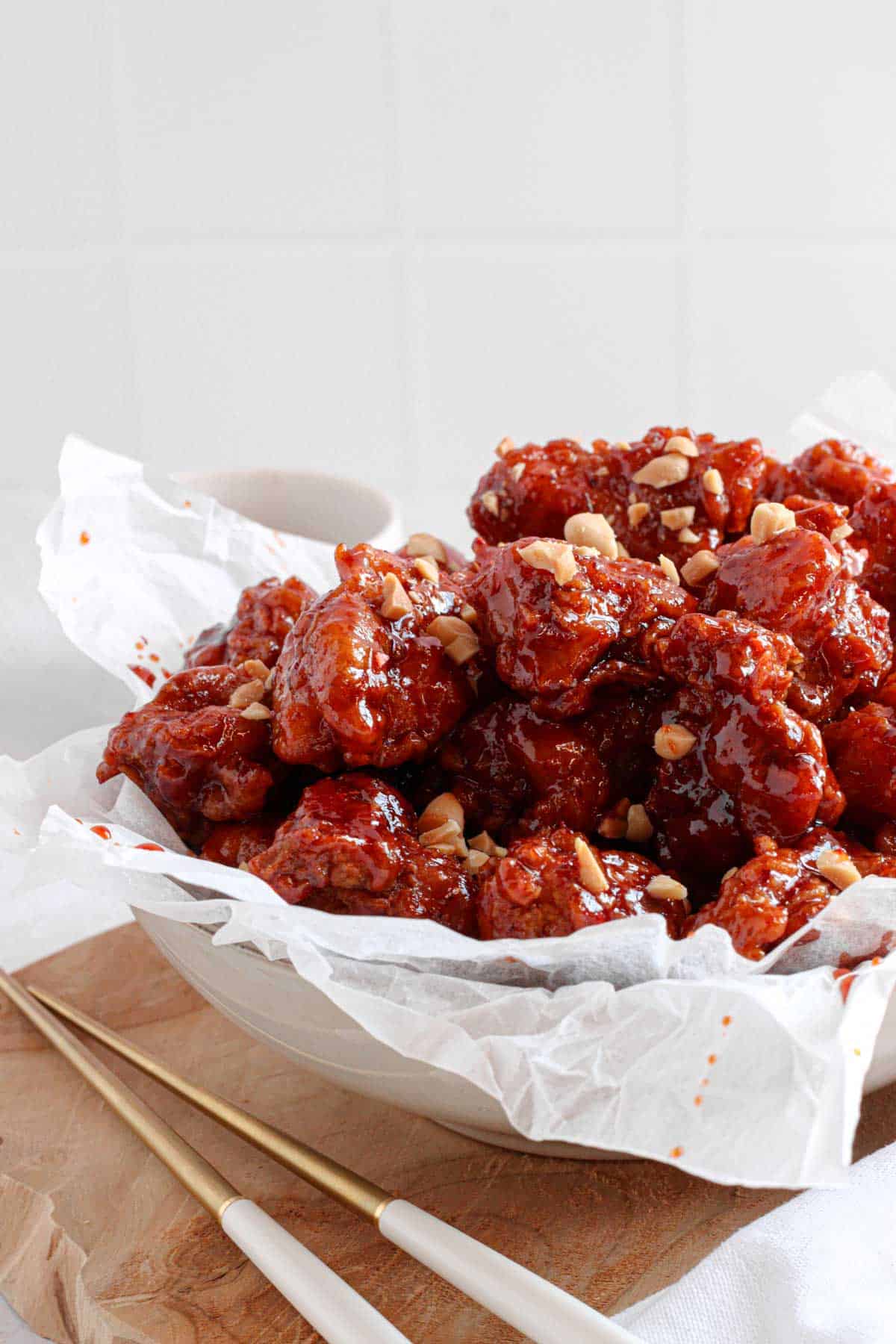
The chicken pieces are crisp on the outside, juicy inside and coated in a thick gochujang sauce that’s sweet, spicy and slightly sticky. I finish mine with crushed peanuts for a little extra crunch.
What is dakgangjeong?
Dakgangjeong (닭강정) is a Korean fried chicken dish made with small pieces of chicken that are fried until crisp, then coated in a sweet, sticky glaze. It can be made in different flavors. This version is spicy and uses gochujang and gochugaru.
Dakgangjeong is made with bite-size pieces, which makes it easy to snack on or share. You’ll find it at fried-chicken shops, markets and takeout spots in Korea.
It’s different from yangnyeom chicken, although the two can look similar. Dakgangjeong generally has smaller pieces and a thicker, stickier glaze, while yangnyeom chicken tends to be saucier and is often served as larger pieces of fried chicken. These are common differences rather than strict rules, as recipes vary.
Korean fried chicken also comes in plenty of other styles, including plain fried chicken and versions coated in soy-based sauces. If you prefer something less spicy, try my soy garlic Korean fried chicken.
Why this dakgangjeong stays crispy
I double-fry the chicken to get a crisp coating before adding the sauce.
The first fry at 320°F (160°C) cooks the chicken most of the way through. I then raise the oil to 360°F (180°C) and fry it again briefly to crisp up the outside.
I also keep the batter fairly thick and coat the battered chicken in an extra layer of dry Korean fried chicken mix. That creates the thicker crust I like for this recipe.

Ingredients
- Boneless chicken thighs – I prefer thighs here because they stay juicier during the double fry. Chicken breast can dry out more easily.
- Garlic – mix it directly with the chicken before coating.
- Salt and pepper – just enough to season the chicken before frying.
- Korean fried chicken mix – use some in the batter and some as a dry coating around the chicken. If you can’t find it, you can use my homemade Korean fried chicken mix instead.
- Unsalted peanuts – optional, but I like the extra crunch on top. Use unsalted peanuts so the sauce doesn’t become too salty.
For the batter:
- Korean fried chicken mix – the water-to-mix ratio varies by brand or flour type. Some absorb more water than others, so adjust accordingly. Aim for a somewhat thick but still pourable batter
- Cold water – mix with the fried chicken powder to make the batter. Keep the batter thick but still pourable.
NOTE: Be careful! Ready-made flours can vary significantly from brand to brand. Some absorb much more water than others. With Ottogi flour (the one I use most often), a flour-to-water ratio of 1½:1 (210g / 240ml) works perfectly. However, Beksul brand flour absorbs much more water, so in that case, it’s better to use a ratio of 1:1 (210g / 360ml).
If you’re using my homemade Korean fried chicken flour recipe, it will depend on the type of flour you’re using. Start with a flour-to-water ratio of 1:1. If the batter seems too runny, adjust to 1½:1.
For the sauce:
- Oligo syrup – in case you cannot find the Korean oligo syrup (올리고당) you can substitute it with mulyeot (Korean corn syrup).
- Mulyeot (Korean corn syrup) – check my FAQ section to find out which substitutes are the best options if you can’t find mulyeot.
- Ketchup – adds sweetness and acidity to the sauce.
- Gochujang (Korean red pepper paste) – the base of the spicy glaze. If you’re new to it, my gochujang guide explains what it tastes like and how it’s used.
- Gochugaru (Korean red pepper flakes) – adds extra heat. Reduce or omit it for a milder version.
- Soy sauce – adds salt and savory flavor.
- Water

Preparation
- Chop the chicken into smaller bite sizes (depending on how big you want them)
- Season the chicken pieces with minced garlic and a pinch of salt and pepper.

- Combine and mix all the sauce ingredients. You can adjust the spiciness by decreasing the amount of gochujang and gochugaru. The gochugaru makes the sauce spicier but it is not necessary if you prefer a softer spicy taste. On the other hand, gochujang should not be omitted, reduce it to max 1 tbsp.

- In a bowl, mix the Korean fried chicken powder with water.
- Add the chicken bites to the batter and coat the pieces well. Then drop the chicken in a plate/bowl filled with fried chicken powder and coat properly. This will make your fried chicken extra crunchy. (If you have a large container, you can also place 2/3 of the dry chicken mix in it, drop the chicken on top and sprinkle with the remaining 1/3 chicken mix. Close the lid and shake a few times so all chicken is well coated with the chicken powder mix).


- Heat up some cooking oil in a pan, pot or fryer. Fry the chicken at 160°C / 320°F for about 6 min or until ¾ cooked. Do this per batch as all the chicken will not fit in your cooking pot, plus your chicken bites may stick to each other if overcrowding your pot. Remove chicken from frying oil and place it on a rack lined with a paper towel to absorb excess oil.
- Increase the heat to 180°C / 360°F. Use the double frying method: fry the chicken a second time for 1 min. Do this per batch also. The chicken should be golden brown. Since everyone has a different stove, and chicken may fry at a different speed according to your stove, cut one piece to check if the chicken is cooked inside. If not, fry it again a little longer.


- In a separate pan, pour the sauce and cook it on medium heat for about 4 min or until the sauce has thickened a little.
- Add the fried chicken to the sauce, and mix well.

- Sprinkle some unsalted crushed peanuts.

Can’t find Korean fried chicken mix?
Can’t find a ready-made Korean fried chicken mix? No worries, here is my Korean fried chicken mix recipe to make your own with basic ingredients you can find at any supermarket (or already have at home).
Variations and substitutions
- Less spicy – reduce or leave out the gochugaru. You can also reduce the gochujang slightly, but I’d keep at least 1 tablespoon so the sauce still tastes like this version.
- Soy garlic – if you want Korean fried chicken without the spicy gochujang glaze, make my soy garlic Korean fried chicken instead.
- Chicken breast – you can use it, but keep a closer eye on the frying time because it dries out more quickly than thighs.
For a meat-free version with a similar sweet-and-spicy glaze, try my dubu gangjeong.
How to serve dakgangjeong
In Korea, fried chicken is commonly eaten as a snack, a meal or anju, food served with drinks. Fried chicken and beer are such a common pairing that it has its own nickname, chimaek.
That’s also one of my favorite ways to eat dakgangjeong when I’m in Korea: at a bar with a cold beer.
At home, I usually turn it into a full meal with steamed rice and a few banchan. If you need a refresher on the rice, here’s my guide to cooking rice.
You can also serve it alongside something lighter or less saucy, like vegetables or pickles, to balance the fried chicken.
How to store and reheat
Store leftovers in an airtight container in the refrigerator.
Because the chicken is already coated in sauce, it will lose some crispness as it sits.
For reheating, I prefer the oven or air fryer over the microwave because dry heat does a better job of bringing back some of the crisp texture.
I wouldn’t freeze the finished glazed chicken if texture is your priority. If you want to prep ahead, it’s better to keep the sauce separate and coat the chicken closer to serving.
Emma’s tips
- Keep the batter thick – a thicker batter plus the dry coating gives you the substantial crispy crust I like for dakgangjeong.
- Check your fried chicken mix – different brands absorb water very differently. Ottogi and Beksul do not behave the same, so don’t rely on one fixed ratio for every brand.
- Fry in batches – overcrowding drops the oil temperature and makes the chicken harder to crisp evenly.
- Use a rack after frying – it lets excess oil drain without trapping steam underneath the chicken.
- Heat the sauce before adding the chicken – let it thicken slightly first, then toss in the fried chicken so the glaze coats rather than soaks the crust.
- Use unsalted peanuts – the glaze already contains soy sauce, so salted peanuts can push the finished dish too far.
RECIPE FAQ
In the mood for Asian fried food?
- Dubu Gangjeong – Korean Sweet and Crunchy Tofu
- Nems – Vietnamese Fried Spring Rolls
- Korean Corn Dogs
- Fried Coconut Shrimps
PSSST… WANT COZY RECIPES?
If you make this recipe, leave a comment and a ★ rating to share what you thought. It really helps me keep bringing you new recipes!
Don’t forget to sign up for my newsletter and get your free ebook with 8 authentic Korean recipes, plus my latest recipes straight to your inbox.
Bite-Size Spicy Korean Fried Chicken (Dakgangjeong)
Save This Recipe!
I’ll email you this recipe so you can come back to it anytime — plus, more delicious recipes in your inbox.
Ingredients
- 500 g boneless chicken thighs
- 1 garlic clove , minced
- salt and pepper
- 150 g Korean fried chicken mix | for coating (Note 1)
- 1 bottle of cooking oil
- 20 g unsalted peanuts, crushed (optional) (Note 6)
For the batter:
- 210 g Korean fried chicken mix (Note 2)
- 240 ml cold water (Note 3)
For the sauce:
- 160 g oligo syrup
- 80 g mulyeot | Korean corn syrup (Note 4)
- 70 g ketchup
- 1.5 tbsp gochujang | Korean red pepper paste
- 2 tsp gochugaru | Korean red pepper flakes
- 2 tbsp soy sauce
- 3 tbsp water
Instructions
- Prepare the chicken – Chop the chicken into bite-size (depending on how big you want them)
- Season the chicken pieces with minced garlic and a pinch of salt and pepper.
- Prepare the sauce – Combine and mix all the sauce ingredients. You can adjust the spiciness by decreasing the amount of gochugaru. The gochugaru makes the sauce spicier but it is not necessary if you prefer a less spicy taste.
- Prepare the batter – In a bowl, mix the Korean fried chicken powder with water. The water-to-mix ratio varies by brand or flour type. Some absorb more water than others, so adjust accordingly. Aim for a somewhat thick but still pourable batter (see photo).

- Add the chicken bites to the batter and coat the pieces well. Then drop the chicken in a plate/bowl filled with fried chicken powder and coat properly. This will make your fried chicken extra crunchy. (If you have a large container, you can also place 2/3 of the dry chicken mix in it, drop the chicken on top and sprinkle with the remaining 1/3 chicken mix. Close the lid and shake a few times so all chicken is well coated with the chicken powder mix)
- Fry the chicken – Heat up some cooking oil in a pan, pot or fryer. Fry the chicken at 160°C / 320°F for about 6 min or until ¾ cooked (Note 5). Do this per batch as all the chicken will not fit in your cooking pot, plus your chicken bites may stick to each other if overcrowding your pot. Remove chicken from frying oil and place it on a rack lined with a paper towel to absorb excess oil.
- Increase the heat to 180°C / 360°F. Use the double frying method: fry the chicken a second time for 1 min. Do this per batch also. The chicken should be golden brown. Since everyone has a different stove, and chicken may fry at a different speed according to your stove, cut one piece to check if the chicken is cooked inside. If not, fry it again a little longer.
- Coat fried chicken with sauce – In a separate pan, pour the sauce and cook it on medium heat for about 3-4 min or until the sauce has thickened a little.
- Add the fried chicken to the sauce, and mix well.
- Garnish – Sprinkle some crushed unsalted peanuts.
recipe notes
- With Ottogi flour (the one I use most often), a flour-to-water ratio of 1½ : 1 (210 g flour / 240 ml water) works perfectly.
- Beksul flour absorbs much more water, so in that case it’s better to use a 1 : 1 ratio (210 g flour / 360 ml water).
Nutrition
The nutritional details provided on That Cute Dish are for informational purposes only and are automatically calculated. Please consider them as estimates rather than precise values, as ingredients and measurements can vary.