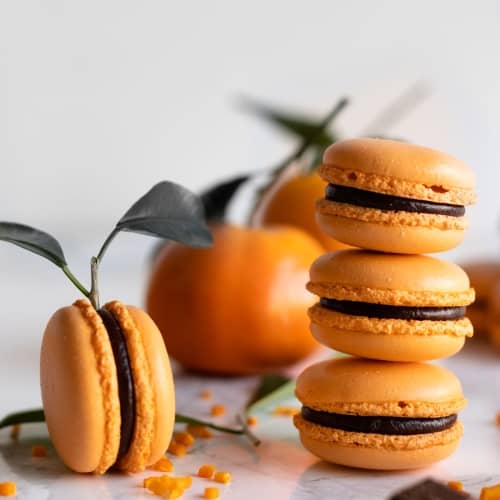
Mandarin Chocolate Macarons
Get macarons right! This recipe will give you the perfect macarons with smooth and shiny shells that will melt in your mouth, leaving you with a subtle mandarin and chocolate taste. No drying time needed!
Yield: 25 macarons
Calories: 83kcal
Equipment
- Piping bag + nozzle (diameter: 1 cm / 0.4 inch)
- Baking tray (optional)
Ingredients
meringue
- 100 g almond powder
- 100 g icing sugar
- 80 g egg whites at room temperature
- 80 g caster sugar
- orange gel food coloring | or powder food coloring
chocolate ganache
- 65 ml cream
- ½ mandarin zest
- 90 g dark chocolate
- 25 ml mandarin juice
Instructions
Make the chocolate ganache
- Chop the chocolate into small pieces.
- In a saucepan, add cream and mandarin zest. Bring it to a boil.
- Pour the hot cream over the chocolate and combine together until smooth.
- Add in the mandarin juice and mix well.
- Refrigerate for 2 hours.
Make the macarons
- Prepare dry ingredients – In a food processor, blend almond powder and icing sugar until fine. Do not overmix, or it will form a paste (Note 1).
- Whip the meringue – In a mixing bowl, combine egg whites and caster sugar (Note 2). Beat with a mixer on medium-low speed for 3-4 minutes, until large bubbles disappear. Increase speed to medium-high and beat for 3-4 minutes, adding orange food coloring at this stage (Note 3). Finally, increase speed to high until firm peaks form, and the meringue clumps around the mixer whisks (Note 4).
- Combine dry ingredients – Sift the almond powder and icing sugar mixture over the meringue. Discard any coarse bits.
- Macaronage (folding) – Using a spatula, fold the mixture gently but firmly against the bowl’s sides. No need to be gentle. This process will help break bubbles and smooth the meringue. While folding, keep checking the consistency of the meringue. Continue folding until the meringue flows slowly in a ribbon-like consistency. Stop folding immediately at this stage (Note 4).
- Pipe the macarons – Preheat the oven to 250°F / 120°C on convection mode.
- Fill a piping bag fitted with a 0.4 inch (1 cm) nozzle.
- Secure baking paper over a macaron template, and pipe the batter vertically. Cut off the flow with a circular motion.
- Tap and dry – Transfer the baking paper and macarons onto a baking tray. Tap the tray on a flat surface to release air bubbles (do this several times). It will help smoothing any imperfections.
- Place the macarons in the oven, turn off the heat, and leave the convection fan running with the door slightly open (1 inch / 2-3 cm). Let the macarons dry for 2 minutes (Note 6). This will dry the macaron shells instead of leaving them dry at room temperature for 1 hour. This process also gives shinier shells.
- Bake – Close the oven door and increase the temperature to 265°F / 130°C (Note 5). Bake for 10-14 minutes (adjust for your oven - mine requires 13 minutes.).
- When done, turn off the heat and leave the macarons in the oven with the door slightly ajar (1 inch / 2-3 cm) for 2 minutes.
- Cool and fill – Take out the macarons. Let the macarons cool completely. They should release easily from the baking paper. If sticky, they’re undercooked.
- Pipe chocolate ganache onto half the shells and sandwich them with the other halves.
- Refrigerate the filled macarons for at least one night. They are best after 2 days, as the ganache moistens the shells.
Notes
1. Almond powder: Quickly process the almond powder in a food processor to make it as fine as possible. This improves your chances of achieving smooth macaron shells.
2. Caster sugar: Adding the sugar all at once or gradually to the egg whites does not make any difference. For simplicity, you can add it all at once before starting to beat the whites.
3. Food coloring: The amount of food coloring required depends on the brand you use, as some brands are more pigmented than others. For macarons, always use gel or powder food coloring. Do not use liquid food coloring, as it may slightly liquefy the meringue and affect the consistency.
4. The two most crucial points:
-
- Firm whites: Beat the egg whites long enough to achieve firm peaks. You know the whites are firm enough when they clump together (agglomerate) in the middle of your whisk attachments. Even if the meringue already holds when you turn the bowl upside down, do not stop beating if the whites haven’t agglomerated on the whisks. If the whites are not firm enough, the meringue will likely be too runny.
- The macaronage: Keep checking the consistency every 2-3 folds to see if the meringue flows slowly in a ribbon-like manner. As soon as it reaches this consistency, immediately transfer it to a piping bag and begin piping. If you do not fold enough, the meringue will be too thick. If you fold too much, the meringue will be too runny. In either case, the macarons will not turn out as they should. Regularly checking the ribbon-like flow is essential for success.
- My oven is particularly strong, so I bake macarons at 130°C (265°F). For most standard ovens, try baking at 140°C (285°F).
- Timing can vary between 10 and 14 minutes. Adjust the timing as necessary.
- Macarons are fully cooked when they release easily from the baking paper. If they are sticky, bake them for a few more minutes.
Nutrition
Serving: 1 macaron | Calories: 83kcal | Carbohydrates: 10g | Protein: 2g | Fat: 4g | Saturated Fat: 2g | Polyunsaturated Fat: 0.1g | Monounsaturated Fat: 1g | Trans Fat: 0.001g | Cholesterol: 3mg | Sodium: 7mg | Potassium: 36mg | Fiber: 1g | Sugar: 8g | Vitamin A: 42IU | Vitamin C: 1mg | Calcium: 13mg | Iron: 1mg
