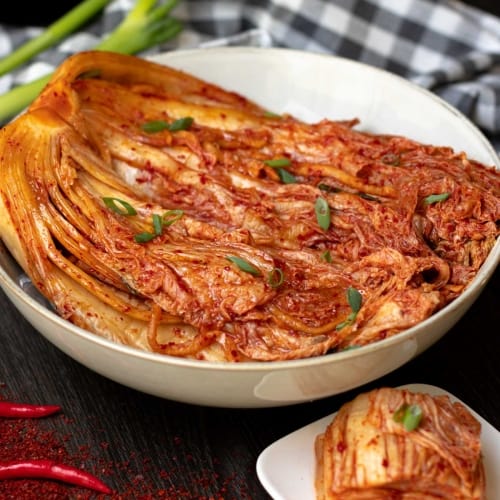
Napa Cabbage Kimchi
Make fresh kimchi at home and you won't ever buy it again from your grocery store! Kimchi is a staple of Korean cuisine, a napa cabbage fermented with Korean radish in a delicious spicy seasoning paste. This recipe is easy to make, super addictive, and most importantly full of flavors!
Yield: 1 cabbage
Calories: 556kcal
Ingredients
- 1 napa cabbage | +- 1.6 kg / 3.5 lbs cabbage is used in this recipe
- 100 g Korean coarse sea salt
Salted water (for soaking)
- 200 g Korean coarse sea salt
- 2½ L water
Kimchi seasoning:
- 250 ml cold water
- 1 tbsp glutinous rice flour
- 2 tbsp white sugar
- 80 g crushed garlic , crushed with a garlic press
- ¾ tbsp ginger , minced
- 3 green onions , cut into 1.2-inch (3 cm) lengths
- ¼ medium-sized onion
- 2 tbsp Korean salted shrimps (saeujot - 새우젓)
- 65 g gochugaru | Korean chili flakes
- 4 tbsp Korean anchovy sauce | myeolchi aekjeot
- 200 g Korean radish , cut into julienne strips
Instructions
Brining the cabbage
- Cut the end of the cabbage in half and tear it into two halves. Make an incision in each half.
- In a large bowl, mix 1 cup of Korean coarse sea salt with 10 cups of water until the salt is dissolved.
- Soak the cabbage in the salted solution, shake off excess water and place the cabbage halves in a large basin.
- Sprinkle sea salt in between each leaf, make sure to add more salt on the stems which are thicker (use about ¼ cup / 50g coarse sea salt for each cabbage halve).
- Let the cabbage rest for 6 hours, rotating the cabbage halves every 1-2 hours. If you’re making multiple cabbages, rotate them as well, moving those on top to the bottom to ensure even brining.
- Once the 6 hours are up, rinse the cabbage in cold water 3 to 4 times to ensure all the salt is washed away.
- Tear each cabbage half where you made the incision.
- Drain the water by placing the cabbage upside down for 1 hour.
Seasoning the cabbage
- In a pot, mix cold water and rice flour, then turn the stove on to medium heat. Stir well and add the sugar. Simmer until it reaches a thick paste. Remove from heat and pour it into a bowl. Let it cool for 30 minutes.
- Add garlic, ginger, onion, and salted shrimp to a food processor and blend into a paste. Transfer it to the rice flour mixture, then add green onion, gochugaru, anchovy sauce, and radish. Mix well.
- Using gloves to protect your hands, spread the seasoning on each cabbage leaf.
Storing the kimchi
- Fold the cabbage quarters in half and place them in an airtight container, filling the container up to a maximum of 80% of its capacity. Push the kimchi down to remove any air pockets. Place plastic wrap on top of the kimchi, ensuring there are no air holes. Seal the container.
- Leave the container at room temperature for about 2 days to allow fermentation to start. After 2 days, place the kimchi in the fridge to continue fermenting. Allow it to ferment for 2 weeks; however, if you prefer young kimchi, you can start eating it right away.
- Every time you open the container, make sure to pat down the kimchi and seal it correctly to prevent mold from forming.
Notes
1. If you can't find Korean radish, simply omit it from the recipe.
2. For brining, do not use regular salt; only coarse sea salt is appropriate for brining cabbage. I recommend Korean coarse sea salt.
Nutrition
Calories: 556kcal | Carbohydrates: 108g | Protein: 31g | Fat: 13g | Saturated Fat: 2g | Polyunsaturated Fat: 7g | Monounsaturated Fat: 3g | Cholesterol: 48mg | Sodium: 51417mg | Potassium: 4207mg | Fiber: 41g | Sugar: 48g | Vitamin A: 22383IU | Vitamin C: 300mg | Calcium: 1120mg | Iron: 16mg
